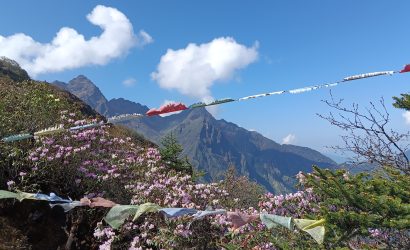
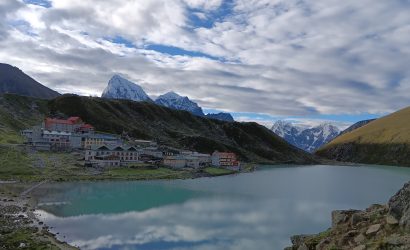
Chulu West peak climbing (6,584m) is one of the popular trekking peaks situated high above the Manang Valley in the Annapurna region. This peak is a part of the Mount Manang. Climb to Chulu west is technically difficult and challenging. One should be well equipped with the use of climbing equipment like: crampons, harness, and ice axe, tying knots and handling ropes. Most of the climbing expedition involves walking on rope while the crossing the glacier.
From the summit one can enjoy close- up views of the Annapurna range that includes Annapurna I, III and IV, Gangapurna, Glacier Dome, Dhaulagiri, Tilicho Peak and Manaslu. In fact, there exists Chulu West and Chulu East in the Chulu massif of the Manang Himal and it creates a great confusion for the climbers with regard to the name and location of the peak. It is really difficult to ascertain which peak is Chulu East and Chulu West.
Only experienced climbers can differentiate the Chulu East. Many climbers are still confused regarding the exact location of these two peaks because there are 4 and more summits are seen in the same periphery, all the summits are not properly marked in maps of the area. As a consequence many climbers have mistakenly scaled one of these peaks assuming it to be Chulu East. Climbing to either Chulu East or Chulu West or both of these peaks is combined with Nepal’s most popular Annapurna Circuit trek and this trip makes up for one of the most scenic Himalayan trekking and climbing.
Overview
Chulu East Peak Climbing (6584m) is one of the most beautiful peaks located in the whole Himalayas. This beautiful peak lies in the Annapurna Mountain Range. Chulu East Peak Climbing is also part of the Damodar Himal. This peak is graded as a less technical peak. If you are thinking of this mountaineering adventure, we recommend you have some mountaineering experience. The knowledge about the use of mountaineering gears and equipment such as crampons, harnesses, ice ax, tying knots, handling climbing ropes, etc. is a must for this adventure.
Trip Highlights
- Chulu East Peak is one of the highly-rated trekking peaks in Nepal.
- Chulu East Peak is the straightforward trekking peak in the Annapurna region.
- Explore the beautiful Gurung Villages in Annapurna Region.
- Chulu East Peak Climbing trip is a combined trekking experience with the most popular Annapurna Circuit Trekki
- Chulu East Peak Summit climbers enjoy the panoramic views of the Annapurna, Dhaulagiri and Manaslu Himalayan ranges.
Itinerary
Upon our arrival at Tribhuvan International Airport (TIA) in Kathmandu, we will be warmly greeted by a representative from Everest Alpine Trekking. In the evening upon our reception, Everest Alpine Trekking will organize a Welcome Dinner at an excellent traditional Nepalese restaurant where we enjoy a Nepalese cultural program as well as a fine meal. Included meal: Dinner.
Today after breakfast we start a guided tour to several nof the most historical and spiritual attractions in Kathmandu. Some of these landmarks are considered World Heritage Sites; including the historic Durbar Square, the sacred Hindu temple of Pashupati Nath, the famous ‘Monkey Temple’ (Swayambhunath) and Buddhists shrine (BouddhaNath) which is one of the large Stupas in the world. At noon, there will be a pre-trip discussion where we can meet our trek leader and other team members. Everest Alpine Trekking briefs us regarding our trek as well as provides us with an opportunity to ask any questions we may have regarding our upcoming adventure. Overnight at Kathmandu.
We have to begin very early today as we need to go a long drive to reach our trek starting point. After breakfast, we leave Kathmandu at around 7 am and nearly after 8-10 hours’ drive we reach Syange or Jagat (as per situation) via Besishahar. En route, we see more of the countryside of Nepal that offers greeneries, rivers, villages, farms and beautiful mountain sceneries. However, the condition of the road is not equally fine in all portion of our drive today. The road up to Besishahar is a coal-tarred road, whereas after Besishahar the road is dusty and coarse though we can easily overlook it as we watch the outstanding sceneries through the windowpane. Overnight stay at Syange or Jagat Guesthouse.
Upon our breakfast, we start our journey today in a relaxed way. We enter Manang district after crossing a large bridge near Tal. The trail continues through barley, rice, potato fields, and pine forests. After passing the village of Kodo we will be at Dharapani, one of the big villages in the Manang valley. Overnight at Dharapani.
Today, we negotiate a few steep forested ridges along with several landslides on the route on the west. On the way to Chame, we encounter with the most sensational views of Lamjung Himal, Annapurna II, and Annapurna IV (7,525m). Small hot springs add relief on our long day hard trek. Chame is the administrative center of the Manang District.
There are two routes that we can follow today. If taken upper route (Nepal Everest Base Camp Treks recommends), i.e., the route through Upper Pisang via Geru, the sceneries will be outstanding. We feel like we are horizontally in front of the majestic peaks. The panoramic views of the mountain peaks, such as Annapurna, Pisang peak, and several others will definitely allure us. We notice a contrast with the landscape and vegetation from today onwards. The cold and dry climate creates a much harsher environment. We pay our memorable visit to Barge monastery, the largest in the entire district of Manang. Overnight in Manang.
Today is the scheduled acclimatization day. It is not recommended to stay idle but a short walk to higher altitude will be better to get acclimatized with the altitude. Manang is a good place to do that as the next two days will be a very challenging and tiring trek for us with the rapid gain in altitude. We should never be confident with the altitude and always be cautious. Bhojo Gompa or Gangapurna Lake is worth visiting sites from the acclimatization point of view. We make an easy excursion to a little distance away to a village called Varga, a small old village with a monastery. At this juncture, we also make our short visit to the Himalayan Rescue Association where we can get some ideas about Mountain Sickness. Overnight at Manang.
From Manang, we continue through alpine landscapes with high altitude vegetation and forests. A gradual ascent takes us to Yak Kharka and then to our today’s camp. Our today’s camp area is mostly used as the alpine pasture by the local people.
Today, we continue our trekking from Leder to Chulu West Base Camp. From the Base Camp, we can enjoy the views of Annapurna Himalayas. We may also like to discover the surrounding areas. At this point, we will set up our camp for an overnight stay.
From the Chulu Base Camp, we continue hiking towards Camp I. The route is not that technical. But it would be better to remember that we are climbing at high altitudes. At this juncture, we relish the magnificent views of Annapurna II and Dhaulagiri mountains including Manaslu, Gangapurna, and Lamjung Himal.
Today, we leave camp I and continue climbing the rock band to Camp II. The route is not that technical but we may have to use ropes, crampon, and ice-ax. We set up Camp II at 5,530m. Some visitors also attempt the summit directly from Camp I. However, since the climb is relatively straightforward from the Camp II until the summit, we make an overnight stay at Camp II for proper rest and acclimatization.
It is our summit day, and it is going to be a long day. Therefore, we would wake up much earlier today. Each moment we have to work hard through the icy high-altitude trail but the outstanding high Himalayan scenes are such tempting that our eyes love to watch more over the horizon than on our trail. After the summit, we return back to Camp I.
After the successful ascent of the Chulu West Peak, we shall now head for the base of challenging Thorong La Pass. Retracing back the trail leading to the base camp we go back the same trail till Ledder and then trek in the northern direction towards the challenging pass. During the trek towards the pass, you get to cross several small streams flown out of the Chulu East and Chulu West peaks and trek past some landslide-prone areas besides some sparsely located tea shops. After the trek of around 6 hours, you shall reach the base of the pass known as Thorung Phedi. Depending upon the fitness level, interest, and other circumstances trekking guide may decide to trek higher up to the High Camp. Stay overnight in Thorung Phedi or High Camp.
Today we shall have another challenging day of our trekking beside the summit of Chulu West Peak a few days earlier. Starting from the Thorung Phedi, the first section of the trail is very steep as the trek from base camp to high camp ascents to a higher altitude in a quick fashion. The trail then eases out as we approach the top. Though the trail eases out after an initial steep phase, the higher altitude still makes it difficult for the trekkers. After trekking for about 4 hours and crossing numerous false summits, trekkers reach the top of the Thorung La Pass (5,416m/17,769ft.). The sight from Thorung La Pass, arguably the largest pass in the world, is marvelous. Trekkers get to witness the view of majestic peaks of the Annapurna range, the beautiful valleys, and gorge formed by the torrential Kali Gandaki River, and the snow-capped peaks to the far in Tibet. After spending some time at the summit of the pass you shall then descend from the pass, slowly and gradually. Though the trail from the pass is gentle at the beginning, it turns out to be steep and winding in several sections until it reaches the grassy slopes at the foothills of the challenging pass. Ahead of the foothills of the pass, the trail leads us to the settlement of Chaharu past the ruins of Yak Herder’s nest, and then to the holy pilgrimage of Muktinath. Stay overnight in Muktinath.
Get amused at the beauty of the region and the exemplary religious harmony displayed at the Muktinath Temple, the temple of Hindu God whose name means “God of Salvation” in Hindu and “Nirvana” in Buddhism. Prayers are made to the god by both the Hindus and the Buddhists; there are temples and gompas in the surrounding areas of the temple and the heritages are dedicated to Hindu and Buddhist deities. The flame ignited due to geothermal heat and the 108 holy taps believed to wash the sins of pilgrims are the other attractions of this sacred destination. We trek ahead of this holy destination, where the pilgrims flock from India as well, and move to another scenic settlement of Kagbeni. The trail ahead starts just ahead of Muktinath Temple and proceeds in a twisting trail through small settlements, several Chortens, and prayer wheels to reach Dzong and further ahead to Putak. Ahead of Putak, you shall walk through the barren landscape and beautiful views of the mountains. As you cross the highest point before descending to Kagbeni the atmosphere gets windy. You reach scenic Kagebeni after you have a short steep descent down a gully. Stay overnight in Kagbeni.
After trekking in the arid and windy landscape of Kagbeni, today you shall follow the trails of Kali Gandaki River as you are heading for Jomsom. Situated at the Kali Gandaki valley, Kagbeni was once one of the major trade routes between Tibet and India and the fortified arrangement of houses shows the importance of this place in the past heydays. We start early from Kagbeni so as to avoid the strong and dusty wind blowing up the valley in the section between Kagbeni and Kalopani. The trail continues along the Kali Gandaki River and traverses through the ruins of the village, and several lively settlements including Ekle Bhatti. The trail from Ekle Bhatti to Jomsom is an easy trail that takes trekkers through sand beaches formed by the river, some ancient gompas, and other such heritages and along the road that takes people and goods to and from Jomsom to upper areas including Muktinath. Stay overnight in Jomsom, a scenic village that hosts important offices including the ACAP office and Army Mountaineering, some temples, Mustang Museum, hospital, and other establishments.
The adventure in the enchanting Annapurna region and the once restricted areas of Manang and Mustang, we shall leave for Pokhara. This marks the end of our adventurous trekking. The flight to Pokhara from Jomsom starts early in the day as in the afternoon the weather creates disturbances for the flight to take place. Flying above the contrasting landscapes, above the deepest gorge and the lush valley created by Kali Gandaki River, with the view of glittering mountains including the Annapurna massifs we reach the scenic city and the unofficial tourist capital of Nepal, Pokhara city. After relaxing we shall move in for the excursion around the Pokhara valley. This Lake City has a lot to offer tourists. From the famous Phewa Lake (on clear weather days we can see the reflection of Fishtail Mountain on the lake) to the shy Devis Falls, from the Mahendra Cave named after the former king of the Shah dynasty to the Gupteshwor Mahadev cave with the shrine of Lord Shiva you have many sites to explore. The International Mountaineering Museum provides information on the Himalayas, mountaineering, and the culture of the inhabitants around the valley. After exploring the diverse nature sites, get back to the hotel for your stay. Overnight stay in Pokhara.
Today upon our breakfast, we make a 200 kilometers drive back to Kathmandu from Pokhara. It will be better to hold on the left pane of the vehicle to enjoy the scenery through the route. Upon arrival in Kathmandu, we will be escorted to our hotel. There is nothing to do but trade emails with travel companions and organize the photos. We can spend the evening either leisurely or perhaps catch up on some last-minute shopping. Finally, we celebrate dinner together with Everest Alpine Trekking staffs.
Our journey in Nepal comes to an end today, Everest Alpine Trekking escort us to the airport for our flight time. Approximately 3 hours before our scheduled flight, a representative from Everest Alpine Trekking will escort us to the airport and bid farewell greetings. On our way to home, we will have plenty of time to plan our next adventure in a wonderful country like Nepal.
Cost Includes
- PERMITS: All essential Permits.
- CLIMBING PERMITS: Peak Climbing Permit that is issued by NMA.
- PICKUP AND DROPS: Airport pickup and drop facility on both Domestic and International flights are included.
- CITY ACCOMMODATION: Three-star twin bed-sharing hotel Accommodation in Kathmandu and Pokhara on a Bed / Breakfast basis.
- WELCOME DINNER: Welcome dinner in a typical traditional Nepali restaurant.
- SIGHTSEEING: Half-day guided city sightseeing to two most sacred World Heritage Sites with a paid entrance fee.
- TAXES: All Government and Local tax.
- DOMESTIC FLIGHTS: Domestic flights from JOMSOM / POKHARA and POKHARA / KATHMANDU.
- EQUIPMENT: Fundamental trekking gear like a sleeping bag with fleece liners, Primaloft jacket, Rain Poncho, Yak-Track, Trekking Poles, etc.
- CLIMBING EQUIPMENT: All climbing equipment including climbing boots.
- LODGING: Local Tea-house accommodation on a twin-sharing basis – A single supplement is provided on request OVER MINIMAL COST, however, depends solely on the availability.
- DRINKING WATER: Properly boiled hot water for drinking is provided every evening and morning – so it’s wise to have bottles equivalent to 3 liters or bottles along with a Rehydration Bag (camel bag).
- GLORIOUS FOOD: Meals (Lunch, dinner, breakfast with hot beverages) during the trek.
- CAMPING: Two-member tents facility and kitchen crew at Chulu Far East base camp with hot meals.
- TREK LEADER: An accomplished Trekking Group Leader (Legitimate Guiding License Holder) and assistant guide.
- CLIMBING GUIDE: Highly qualified CLIMBING SHERPA and his climbing Allowance
- PORTER: Strong Professional porters in 1:2 ratio.
- STAFF INSURANCE & ALLOWANCES: All Ground Staff and their Allowances + their insurance.
- SAFETY CONCERNS: Oxygen cylinders and an all-inclusive comprehensive medical kit on all trips + Satellite phone.
- COMPLIMENTARY TAKE AWAY: Take away the Nepal Pyramids duffel bag, T-shirt, Buff (multi-functional head-wear), and trekking Map.
Cost Excludes
- NEPAL VISA: A fee of $50 that is levied on a 30-day Nepali visa.
- INTERNATIONAL AIRFARE: The cost of all international flights.
- PERSONAL EXPENSES: All personal expenses that may include Nepalese SIM card, internet, battery charging, hot shower, laundry, fizzy drinks, Alcohol, etc.
- EMERGENCY: A medical examination of any kind, High Altitude Evacuation over any circumstances, Air Evacuation and Rescues.
- DONATIONS: Donations of any kind.
- STAFF TIPPING: Tipping is entirely a personal matter, however, it’s a trekking culture.
- EXTRA NIGHTS: Extra night accommodation in Kathmandu on early arrival or Late departure.
- SANCTIONS: Permits or the letter of Authorization that is required for special Filming, big Drones, and Filming Cameras.
- INSURANCE: All-inclusive Travel or medical insurance is a must.
- EXTRA PORTER: Over request Extra Porter or Assistant is provided that may include the cost of $25 per day.
- OPTIONAL TOURS: Optional tours and sightseeing or any activities during free time.
FAQS
Chulu East Peak Climbing is situated in the Manang district of Nepal, in the Annapurna region. It is part of the Chulu Massif, which includes Chulu West and Chulu Central peaks.
Chulu East Peak Climbing stands at an elevation of 6585 meters,above sea level.
Chulu East Peak is considered a technically challenging climb. It requires mountaineering skills, including the use of ropes, ice axes, and crampons. Prior climbing experience and good physical fitness are recommended.
Yes, you need to obtain the Chulu East Peak Climbing Permit, which can be obtained in Besisahar or Chame. Additionally, you will also need the Annapurna Conservation Area Permit (ACAP).
The best time to climb Chulu East Peak Climbing is during the spring (March to May) and autumn (September to November) seasons. These months offer stable weather conditions and clear views of the surrounding mountains.
The climbing expedition usually takes around 16 to 21 days, including acclimatization and trekking to the base camp. The duration can vary depending on individual fitness levels and acclimatization needs.
While it is not mandatory, it is highly recommended to hire an experienced guide and porter for the climbing expedition. They can provide guidance, carry heavy loads, and ensure your safety throughout the journey.
Along the trekking route, there are teahouses and lodges where you can stay. However, at higher altitudes, accommodation options are limited, and you may need to camp. It is advisable to carry your own camping gear.
Altitude sickness can be a concern during the climb, as Chulu East Peak climbing reaches a high altitude. It is crucial to acclimatize properly, stay hydrated, and ascend gradually to minimize the risk.
You will need basic mountaineering equipment such as ropes, ice axes, crampons, harness, helmet, and appropriate clothing for extreme weather conditions. It is recommended to consult with an experienced guide for a detailed equipment list.