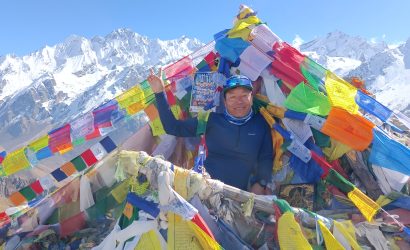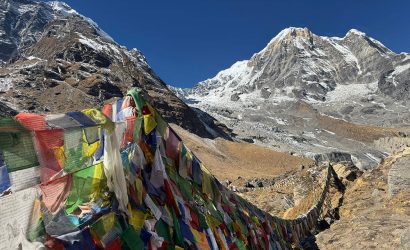


Lower Solukhumbu Cultural Trail Trek for families starts with your arrival in Kathmandu. From Kathmandu, you fly to Phaplu and start trekking. The trail is fairly easy as you walk through the forests and cross suspension bridges. En route, you will see traditional villages and Mani walls as well as prayer flags which symbolize the religious rituals and values practiced in the region. During this journey, you visit many Buddhist monasteries like Taksindu Gompa and Phungmuche monastery and observe the Sherpa way of life. The Sherpa people are very welcoming and will amaze you with their heart-warming hospitality.
You will spend a complete day in Junbesi exploring the village and witnessing the culture of the locals. From there, you trek back to Phaplu and end the trek. The trek route is filled with the breathtaking views of the snow-capped mountains like Number (6959m), Karyolung (6511m) and many others Everest Himalayan range. Autumn (September to November) is an excellent time for this trek as the skies are clear and provide great views. You can also trek (March to May) where the wildflowers bloom.
Overview
Lower Solukhumbu is the ancestral homeland of the Sherpa people, who migrated from eastern Tibet over 500 years ago. Before mountaineering became popular, this area served as an important trade route between Nepal and Tibet, especially for salt, wool, and grain.
The region gained wider recognition after Sir Edmund Hillary and Tenzing Norgay Sherpa passed through Solukhumbu during early Everest expeditions. Unlike Upper Khumbu, Lower Solukhumbu has preserved its traditional lifestyle, monasteries, and farming culture.
Highlights
- Holy Lake Dudhkunda 4560m. (religious pilgrimage place)
- Protector of this valley Numbur Himal.
- Culture of khaling Rai and Sherpa.
- Non Touristic & non crowded Trek.
- Walking through the Rhododendrons , Pine forest and pastureland.
- listen birds & see Monkey.
- Panoramas of Everest, Makalu, Lhotse, Kanchenjunga, and Annapurna.
- Fewer trekkers and quieter trails.
- Stunning sunrise views from Pikey Peak.
Upon your arrival at the Tribhuvan International Airport in Kathmandu and after clearing immigration and customs, you shall be welcomed by a representative of Everest Alpine Trekking who shall transfer you to your respective hotel. After taking a rest for your jetlagged body, explore the immediate surroundings in the vibrant Thamel which hosts diverse shops, and hotels, and is a neighbor to some eminent historical buildings. Enjoy the authentic dinner in the evening and prepare for a sightseeing city tour tomorrow. Stay overnight in Kathmandu.
Today you shall enjoy a city tour in the medieval city of Kathmandu and explore the historical and ancient heritages of prominent value. In a guided tour that shall reflect the rich diversity of this nation, you shall pay a visit to the Buddhist holy places of Swayambhunath (also known as the Monkey Temple) and Boudhanath Stupas which are known for their religious importance, ancient monasteries, and unique cultural ensembles within the premises. Next on the list is the Hindu holy place of Pashupatinath Temple located at the bank of the holy Bagmati River which is one of the most revered pilgrimages all over the world. We shall also explore the rich heritage of Patan Durbar Square, a complex with the ancient royal palace, unique Krishna Temple, museum, resting places, and intricate carvings on the stones and wooden structures on the premises. After this exploration, we shall have an interaction with the trekking guide and get ourselves clarified on the issues related to the trekking. Stay overnight in Kathmandu.
Our trek commences today as we take a drive to Shivalaya. After a succulent breakfast at the hotel, you will be accompanied by our guide. Our vehicle maneuvers through the busy and noisy streets of Kathmandu, past the Newar-dominated towns of Banepa and Bhaktapur. The driving route follows the Bhote Koshi River all the way up to a Tamang village. From here, we drive alongside the Tama Koshi River until we finally arrive at Jiri. Owing to its splendid natural beauty, Jiri is often given the nomenclature of “Switzerland of Nepal” and is gradually becoming the start-off point for most of the treks in the Everest region. From Jiri, we head onward to Shivalaya which is our last destination of the day. The residents here comprise the ethnic mix of Gurungs, Sherpas, Brahmins, Magars, etc. Stay overnight at Shivalaya.
Today we shall wake up early as we have to start hiking from today onwards. Our route today passes through the Shivalaya Police Checkpoint. The tail to Bhandar is marginally steep, and most part of it is embellished with rhododendron clusters. Surmounting the climbs and simultaneously enjoying the rhododendrons, we arrive at Deurali (2,387m) which offers a splendid view of Pike Peak. The local inhabitants of Deurali are mainly Sherpas and Tamangs. Our trail now goes down until we arrive at the settlement of Bhandar. Stay overnight at Bhandar.
From Bhandar, we descend on a downhill route through dense forests, cross a few streams, and then pass by the small settlements of Dokharpa and Baranda. From here, the route climbs through the forests and winds down to the Surma River. We continue trailing through the Likhu River valley. After about 3 hours of walking, we arrive at the village of Kinja village (1,624m), where we halt for lunch. This village happens to be the business hub for Ramechap and Solukhumbu districts. Our trek now resumes along an uphill route, until we eventually arrive at the settlement of Sete. Stay overnight at Sete.
We grab our breakfast and then resume our footy mission, walking up through the jungle. Most part of this walk is through the forest. We arrive at Lamjura Danda and halt for lunch. We have a pass ahead, so after some good energizing lunch, we begin to trudge up the steep route until we get to the top of the Lamjura La Pass (3,532m). From atop, enjoy the splendid views of the peaks like Gauri Shankar, Dudh Kunda, Mera Peak, etc. including the flowery vista of the flashy rhododendrons. After this scenic retreat, we descend from the pass to the Sherpa and Newar-dominated village of Junbesi. Stay overnight at Junbesi.
We shall begin the trek with breakfast from the settlement at Junbesi and start our beautiful section of this trek to Thuptenchholing Gumba. The trek today provides you with an opportunity to observe Sherpa culture and visit monasteries. Junbesi is one of the most beautiful Sherpa villages in the lower Solukhumbu region. It is rich in astonishing landscapes, cultural wealth, and hospitable Sherpa people. In addition to this, you will also experience lush green wilderness and a beautiful landscape. Stay overnight at Thuptenchholing Gumba.
In the trek today we trek along the winding trail through the pine and rhododendron forests, suspension bridges, culturally rich Sherpa villages, and the marvelous views of the mountains all along the trail to Yak Kharka. You walk through alpine forests. You get to experience lush green wilderness amidst beautiful landscapes with close-up views of silver peak mountains. Stay overnight at Yak Kharka.
Today you will see mountain glaciers, Lake Dudh Kunda, and the mountains closely. If you visit during August you can be part of a fair at the Janai Purnima ceremony which is one of the remarkable festivals of Nepal. Bird watchers will also see migratory aquatic birds during the rainy season. Stay overnight at Dudh Kunda.
We get going along the steep route to the Dudh Kunda Base Camp. On reaching the base camp, we pay a visit to Dudh Kunda Lake, which literally means the milk pond. The lake is perched right at the bottom of Numbur Himal, locally known as Shorong Yul Lha, which in the local dialect means the “custodian of Solu Lake”. Hence, both, the mountains as well as the lake have a great religious significance. Huge numbers of Hindu devotees visit the lake to take a holy dip every year. From the base camp, we can relish the views of Dudh Kunda Peak, Numbur I & II, as well as Mera Peak. We then trek back to Saharsbeni. Today’s journey has been a combination of trek and pilgrimage. Stay overnight at Saharsbeni.
On our trekking trail today we shall pass through Kaku and Basa to reach Taksindu where you are able to see some breathtaking panoramic views of mountain peaks, sparkling waterfalls, and tranquil lakes that will entice you to stop. As you continue on, you’ll pass through dense forests of rhododendron, the national flower of Nepal, which are in bloom from March to May. Also in the fall (September to December) when the weather is temperate and the skies are clear you can see these wildflowers in full bloom. Views of flora and fauna, as well as a variety of wildlife, will catch your attention but not slow you down. Stay overnight at Taksindu.
We shall wake up early in the morning with the view of the majestic sunrise glaring onto the lands below. The hike will take about seven hours today as we need to reach Phaplu, where you shall get a flight back to Kathmandu. So today you walk through mixed alpine forests, experience wildlife, and bird watching, and pass through different Sherpa settlements. You also encounter a lot of wildlife and vegetation in this particular region. Upon arrival at Phaplu, if you want you can enjoy some cultural shows which are generally performed on request here. Rest and stay overnight at Phaplu.
We leave early in the morning after breakfast for the flight back to Kathmandu. This scenic flight is as enchanting as it was for the first time we witnessed. The views of hills, green valleys, and picturesque mountains are always tempting for the viewers. After arrival at Kathmandu Airport, you shall be transferred to the hotel of your stay in Thamel by our representative. Explore the streets of Thamel, the buzzing streets and alley markets in the nearby places of Ason, the Royal courtyard and palace in the bit far away Basantapur Durbar Square, and others. You may also do some souvenir shopping in the surrounding areas. In the evening you shall be greeted with a farewell dinner where you can savor the authentic Nepali cuisine.
Our amazing and wonderful Dudh Kunda Trek has come to an end. Today a representative of Everest Alpine Trekking shall escort you to the Tribhuvan International Airport for the flight to the onward destination at least three hours prior to the flight. We would like to express our gratitude for joining our trekking team for this wonderful and exciting trekking expedition and hope that we shall be welcoming you to other adventurous activities in this beautiful Himalayan nation. We hope that the trekking experience on this ‘less traveled’ path created a lifelong memory for the trekkers and you are tempted to return on subsequent visits to this beautiful Himalayan nation.
Cost Includes
- Pick up and drop off from Kathmandu International Airport to hotel.
- Ground transport (Kathmandu–Salleri–Kathmandu).
- Trekking permits and fees.
- Licensed trekking guide.
- Porter (optional).
- Accommodation during trek.
- Meals (breakfast, lunch, dinner).
- First-aid kit.
Cost Excludes
- International flights.
- Nepal visa fees.
- Travel insurance.
- Personal expenses (snacks, drinks, Wi-Fi).
- Tips for guide and porter.
- Emergency evacuation (if needed).
FAQS
The Lower Solukhumbu Trek is located in the southern part of Nepal’s Everest (Khumbu) region, below the busy Everest Base Camp trail. It includes villages such as Salleri, Ringmo, Junbesi, Taksindu, Phaplu, and Pikey Peak.
Lower Solukhumbu focuses on culture, villages, monasteries, and mid-hill landscapes, while Everest Base Camp is more about high altitude and glaciers. This trek has fewer crowds, lower altitude, no Lukla flight, and offers a more authentic Sherpa lifestyle experience.
This highest point is Pikey Peak (3,650 meters), which offers one of the best panoramic sunrise views of the Himalayas, including Mount Everest.
Yes. This trek is considered easy to moderate and is suitable for:
01: First-time trekkers.
02: Families and older travelers.
03: Cultural and nature lovers.
04: Trekkers who want to avoid altitude sickness.
No. One of the major advantages of the Lower Solukhumbu Trek is that no Lukla flight is required. The trek starts with a scenic drive from Kathmandu to Salleri or Phaplu.
01: Sagarmatha National Park Entry Permit.
02: Khumbu Pasang Lhamu Rural Municipality Permit.
03: A TIMS card is not required for Everest region treks.
“The best seasons are”
01: Spring (March–May): Rhododendron blooms and clear views
02: Autumn (September–November): Stable weather and best visibility
03:Winter is cold but quiet, while monsoon is green but rainy.
The trek typically lasts 7 to 12 days, depending on:
01: Route selection.
02: Side trips (Pikey Peak, monasteries).
03: Pace and acclimatization.
Accommodation is in local teahouses and lodges. Rooms are simple but clean, usually with:
01; Twin beds.
02: Shared bathrooms.
03: Warm dining halls.
Common meals include:
01: Dal Bhat (rice, lentils, vegetables).
02: Sherpa stew.
03: Momos.
04: Tibetan bread.
05: Noodles, pasta, soups.
06: Tea, coffee, and hot lemon.
Altitude sickness is rare on the Lower Solukhumbu Trek due to its moderate elevation. However, proper acclimatization, hydration, and slow walking are still important.
While it is possible to trek independently, hiring a licensed guide is highly recommended for:
01: Cultural understanding.
02: Navigation.
03: Safety.
04: Supporting local employment.
01: Mobile network (NTC/Ncell) is available in most villages.
02: Wi-Fi may be available in some lodges, often for an extra cost.
03: Connectivity can be slow and unreliable.
Basic fitness is enough. You should be able to:
01: Walk 5–7 hours per day.
02: Handle gradual uphill and downhill trails.
03: No technical trekking experience is required.
Yes. Travel insurance is strongly recommended and should cover:
01: Trekking activities.
02: Medical treatment.
03: Emergency helicopter evacuation.
Essential items include:
01: Good trekking shoes.
02: Warm layers.
03: Rain jacket.
04: Daypack.
05: Sunscreen and sunglasses.
06: Basic first-aid kit.
Yes. It can be extended to:
01: Everest Base Camp Trek.
02: Gokyo Lakes Trek.
03: Rolwaling Valley Trek.
04: Upper Solukhumbu (Namche Bazaar) Trek.
Costs vary depending on group size and services, but typically range from USD 700 to 1,250 per person for a full guided package.
Yes. The trek is considered very safe, with friendly local communities and well-established trails. With a guide, safety is even higher.
Choose this trek if you want:
01: Authentic Sherpa culture.
02: Quiet trails.
03; Stunning Himalayan views.
04: Moderate altitude.
05: Budget-friendly trekking.
06: A less commercial Everest experience.
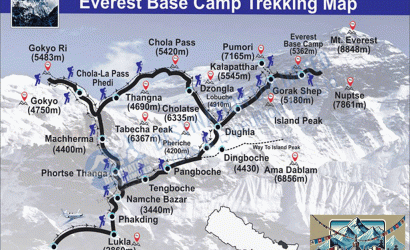
Lower Solukhumbu Trek map