

The Dolpo Great Himalayan Trail Trek is one of the most remote, challenging, and spectacular sections of Nepal’s Great Himalayan Trail (GHT). This route passes through the heart of the Dolpo region in north-western Nepal, linking high Himalayan passes, ancient monasteries, and isolated Tibetan-influenced villages. It represents the true wilderness trekking experience of the GHT.
The Great Himalayan Trail is a long-distance trekking route that stretches across Nepal from Kanchenjunga in the east to Humla in the west, covering the full length of the Himalayas. The Dolpo section is considered one of the wildest and most demanding parts of the trail.
Overview
The Dolpo GHT route runs through Upper and Lower Dolpo, crossing multiple high passes above 5,000 meters, including remote areas inside Shey Phoksundo National Park. It combines rugged mountain scenery, high-altitude desert landscapes, and deeply preserved Tibetan culture.
Trip Highlights
- Rare wildlife including snow leopard and blue sheep.
- Panoramic views of Dhaulagiri and other Himalayan ranges.
- Traditional villages such as Dho Tarap and Saldang.
- Remote high Himalayan passes and hidden valleys.
- Stunning Shey Phoksundo Lake.
- Ancient Bon and Tibetan Buddhist monasteries.
Itinerary
On arrival at Tribhuvan International airport, our representative will be awaiting you to cordially welcome with great hospitality. The representative will be displaying the “Nepal Sanctuary Treks” placard outside the airport terminal. You will be then escorted and transfer to the hotel in our private vehicle. Further details and short preliminary briefing will be provided after transferring to the hotel. You will have leisure time to relax and freshen up.
After early breakfast, we will start our fresh morning by wandering Ason and Indrachowk marketplaces to get a glimpse of traditional Nepalese life. You’ll witness the bustle of the market, see how locals purchase the products and haggle for a bargain. Whilst walking around enjoy the lively and vibrant atmosphere this local market has to offer.
We walk through a narrow alley and see people rushing. Observe the first hand the local produce people from Nepal actually purchase. You will also take in the sights and smells of the market. Your friendly tour guide will explain in full detail all the products and procedures you will see. There is plenty of opportunities to buy something for your selves and lots of photo opportunities to capture in your camera.
Next, we head towards Kathmandu Durbar Square, also called Hanuman Dhoka Durbar, and used to be the residence of the Nepali royal family and administrators. These ancient sites situated in the traditional heart of Kathmandu that incorporates an architecturally extraordinary complex of ancient palaces, temples, courtyards, and shrines dating from the 15th to the 18th century.
The most revered places of Kathmandu Durbar Square is the three-storied temple named Kumari Bahal. The structured like a typical Newari Vihara. In this house lives Kumari, a girl who is respected as the living goddess. During the festival of Indra Jatra, the Kumari is paraded around the square in a custom-built gilded chariot and worshipped by the people.
The tallest temple of Kathmandu valley ‘Taleju Bhawani’ built-in 1549 AD. This temple is deliberated to be the most outstanding work of art in the Durbar square and considered to be the royal goddess.
Jagannath temple built in the 16th century is well-known for erotic carvings, and the Hanuman Dhoka (the royal palace) is situated in Kathmandu Durbar Square.
Kalbhairav is considered to be the destructor form of Lord Shiva. Built-in the 17th century, this, 10 ft. high stone statue of terrifyingly portrayed Kal Bhairav is sited near Jagannath temple.
Temple of Shiva Parvati, rectangular in shape enshrines Nava Durga, a group of goddesses on the ground floor. It has a wooden image of Shiva and Parvati at the window of the upper floor looking out at passerby in Durbar Square.
Swayambhunath:
You are then taken to Swayambhunath (monkey temple) which is the magnificent ancient religious architecture and center faith of Hinduism and Buddhism. Its lofty white dome and dazzling golden spire are visible from far and wide. Upon arriving at the top, you can hear the Buddhist songs “Om Mani Padme Hum” resound everywhere. The candles and the aromatic fragrance of incense that burns constantly create a serene vibe and we can turn the enormous prayer wheels which encircle the stupa.
Boudhanath:
Buddhist shrine of Boudhanath, one of the largest stupa in Nepal as well as the sacred Buddhist sites in Kathmandu. You will observe the monk chant in the prayer hall while people lighting butter lamps and reciting mantras. You can see the vibrant prayer flags tied to the stupa that conveys mantras and prayers into the universe while fluttering in the wind. Traditionally, prayer flags come in sets of five, one in each of five colors. The five colors signify the elements and the Five Pure Lights.
Pashupatinath:
Further, we visit Pashupatinath temple, a Hindu shrine dedicated to Lord Shiva located on the bank of Bagmati River. You can see elaborately dressed holy men meditating outside the temple and pilgrims placing offerings at the shrines. You can also observe people performing the religious ritual and funeral pyres burn at open-air cremation. After visiting fascinating cultural heritage sites, you will transfer back to the Hotel. The evening can either be spent strolling the marketplaces in Kathmandu or resting at the hotel.
After breakfast, our representative will transfer you to the domestic airport for flight to Nepalgunj. During flight, you will see the spectacular vistas of the village, city, forest, and mountain.
It takes around 35 minutes to arrive at Juphal by the flight from Nepalgunj. While on the air, you could see the vistas of Dhaulagiri, Churen Himal, Sisne Himal, and Kanjiroba Himal following all the way up to the Juphal. Upon arriving there, we will trek towards the Shyanta.
After breakfast, we leave Shyanta behind and trek towards Amchi Hospital. This is a very fascinating place and worth a visit. Indeed it is more a clinic, which is well visited by local people. An Amchi is a doctor who is educated in traditional Tibetan medicine, and always is a lama (monk) as well. In the Amchi Hospital, you can observe a collection of herbs and minerals used for treatment you can see the beautiful Tibetan village with flat-roofed houses and fields of buckwheat.
After having our breakfast we begin to trek by passing arid settlement called Palam and climb uphill for an hour to the ridge at about 3800meters (12,467 ft.). Once you reach a view tower you will get to see the spectacular highest waterfall in Nepal and Ringmo Mo Village with Phoksaondo Lake. On the way, you likely to encounter with blue sheep. We walk down through a birch forest passing Chorten and Mani walls at the doorway to Ringmo village. After a short walk, we reach Phoksondo Lake.
Today is important for acclimatization as we will be trekking to higher altitude; altitude sickness can be a problem so to avoid altitude sickness we stay back and let our body adopt the altitude. As we stay back a day hike to Bon monastery which is believed that this religion origin prior to Buddhism, explore Ringo mo village can be organized for acclimatization.
we enter to the north of Phoksondo Lake. The trail offers magnificent views of the lake and amazing Himalaya. We follow the western part of Phoksondo Lake along a narrow cliff trail.
We climb to a ridge with magnificent vistas over the enchanting lake to Ringmo village and the snowcapped mountain of Kanjiroba (6,612m), Norbung Kang (6,085) and Jhyarko Dingla (5,892m). Further, we take a steady decline through birch trees that lead to our Phoksondo Lake North Cam.
After breakfast, we leave Phoksondo North Camp and head towards a wide valley with a couple of river streams. On the left side of valley, you can see superb views of Kanjero Himal. After four hours trek, we will stop for lunch at Dobhan (river confluence) camp. After lunch, we ascend uphill for approximately three hours towards Lar Tsa Camp. Lar-Tsa camp is popularly known for producing Yarchagompa “Caterpillar fungus” which is used by the practitioner of Tibetan and Chinese medicine for cancer and fatigue treatment. You can also see the beautiful view of Kanjiroba Himal (6,612m) from Lar Tsa camp.
We have an early breakfast and begin to trek by walking up to the valley and traverse river on a bridge. Then start walking uphill to the small pass. Then you step towards the narrow gorge. Once you cross narrow gorge you will see Snowfield high camp. After one and half hour trek, you will reach snowfield camp. Snowfields Camp is at the base of Kang La that traverse into Dolpo.
The trail is steep and challenging all the way up to Kang La pass. From the top of the pass, we will be offered with a view of the large valley divided by river. Now we descend steeply to the base of the valley then trek along the bank of the river until we arrive at Shey Gompa, Shey means crystal so the famous Buddhist monastery is located beneath Crystal Peak. Our campsite will set up in a meadow area with several herders.
Today is also a rest day; we stay back in Shey Gompa. After a decent breakfast, we can either rest in the tent or explore the area, an optional day hike will be organized to Tsakang gompa, hours of walk from Shey. We will return back to the camp and stay overnight here.
After an early breakfast, we rejoin our trail, leaving Shey gompa behind. We trek a pleasant trail through juniper trees descending into a grey, stony canyon. From here the trail becomes zigzag and we further trek to the top of Namgung La Pass, from the pass you can enjoy views from the north into Tibet and east towards Mustang. From the top, we then descend northwards to a small village of Namduna Gaon where we will camp the night.
After breakfast, we trek through the Namgung Khola Valley to Karang. Stay overnight at a camp in Karang.
After having breakfast, we carry on our trek by descending to Torak Sumdo (3,670 m) with a confluence of the Polang Khola and Namgung Khola. Further we traverse to the north bank and ascent to Yanger Gompa (3,750 m). Then trek along the river valley to the campsite near the stream. Stay overnight at a camp in Mischagaon.
After having an early breakfast we start to take steep ascent for hours to Muri La Pass. From the pass, you can see the beautiful landscape of the Upper Dolpa area and Tibet. After savoring the view we start to heading down for three hours that lead us to Chapula Goth.
After breakfast, we start to walk downhill for one hour to Shimen village with huge areas of terraced fields of buckwheat, barley, and potatoes. You will see the longest mani wall (600m) of Dolpo. We start walking along the Tinje Khola. We will stop for lunch here. After lunch, we walk along the river and you will see the rocks inscribed in the mantra . Once you get to Phal Gaun, there is a road on the left side of the valley that leads to Tibet. We will continue to trek taking the right side trail towards the beautiful Tinje village of Tibetan settlement. You can still see airstrip which was used during the conflict between Tibet and China in the past. Tinje is the main village in a broad valley with widespread fields with two gompas and an old fort. We stay overnight in camp at Tinje.
After breakfast, we follow Panzang Khola past ruins of an old settlement on the other side of the river, after two hours we arrive at river confluence where we take the left tributary Kehen Khola for a further hour to reach our lunch spot in the grassy area next to the river. After lunch, we continue walking up the left bank of Kehen Khola passing several doksas before arriving at Rakpa where we camp for the night.
After breakfast, we walk the leveled path for one hour and cross the river. Again start walking onto riverside of a different valley that will lead towards Chharka La. if the weather is apparent, you can see the superb view of Dhaulagiri 2. The gradual climbs to the pass take 5 hours walking and further three and a half hours walk leads you to Chharka village. Chharka is the last village of Upper Dolpa. Several years before Chharka was considered as SAKA. In Tibetan words, SAKA means “Good place” and also the hamlet was popular for fine salt since there was salt mine. Salt found in Chharka was the finest one, therefore, the ‘Chharka’ means good salt. Hence, Chharka is titled from Good salt & a good place.
After breakfast, you can take rest or explore around Chharka village. We will explore the two gompas, Buddhist and Bönpo, signifying the two religions of Dolpo. Situated in Chharka village, Sachen Gonpa is Ningmapa sect gompa which was made by Saga Jampa, Dorje Choekyong Sangpo in 1400A.D. Later in 1993 Menla Phunjok of Chharka village had re-built the gompa in the involvement of village dwellers.
The ancestors and heredity of Chharka people are Siro, Habha, Yangton, Tolung, Purang, Nopri, Toyo which were originated from Dulung Village, Mustang, Lasing, Tibet, Poldya of Tinje Village. You can observe diverse people while exploring the village.
On this day, we will be trekking through the most magnificent trails from Chharka to Norbulung. We trek to the trodden way from the caravans of Yaks and people along the way. Norbuling has been named by one of the well-known expeditors George Schaller as a new world of “remote peaks crowned by remoter snows”. Further, we’ll descend from the plateau down to the main river traversing it on a bridge. Stay overnight camping at Molu.
Today we will commence our trek early in the morning. We pass through the meadow of Molum Sumdo and then carry on to a ridge with a cairn at just over 5,100m. Then, it is an additional couple of hours to get Sangda La walking through a lush plateau with grazing yaks. Further, we start ascending the trail to the Sangda La pass marking the boundary among Dolpo and Annapurna. The trail drop on loose rock debris to Sangda Phedi.
After breakfast, we start our today’s trek following Bheri Khola then contour up and ascent the lower
Sangda La at 5,035m. Once you reach the pass you will be rewarded with magnificent towering peaks views over to Kali Gandaki valley and Thorong La and more a range of 6,000m mountains comprising Tongu Himal and Mukot Himal.
There is a sharp descend from the pass on a wobbly trail that traverses a ridge with a cairn at 4,800m then descent to a huge rock at 4,500m. We further trek down to a verdant plateau with pine trees then take right and cross the new suspension bridge at 3,900m.
We take steep ascent and the trail crosses high above Kyalunpa Khola, after an hour we traverse a crest with prayer flags. We trek down through a steep gorge to traverse the tributary river for ½ hour to the second river again crossing on rocks.
In a while, you will see the entrance chorten to Sangda village followed by a huge wall around their fields stay overnight at Sangda village.
After breakfast, we ascend to a hill behind the Sangda. Today we cross numerous ridges and reach the last crest (4280 m). Further, we take to descend to the Annapurna round trail in the Kali Gandaki valley. Then trek through a side of a cliff and trek down to Dhagarjun. Dhagarjun is a huge village with Bhotia people. Stay overnight at a camp in Dhagarjun.
After breakfast, we trek from Dhagarjun to Jomson. Further, we ascend to a ridge at 3360m and make a final descent on a challenging trail of loose rocks to Jomsom at 2670m. Stay overnight at lodge.
After breakfast, we take a flight from Jomsom to Pokhara and onto Kathmandu. After landing in Kathmandu, you will be escorted to your hotel. You will have the afternoon to yourself to explore the city or to relax at the hotel.
After having breakfast at the hotel. You have leisure time to take relax or explore around marketplaces to shop the souvenir for loved ones.
It is time to fly back to home keeping all the terrifying experiences of Nepal in mind.
The representative from Everest Alpine Trekking will transfer you to TIA airport where you should check-in 3 hours prior to your scheduled flight.
Cost Includes
- Airport pick-up and drop-off (international and domestic).
- All ground transportation as per itinerary.
- Domestic flights (as required by the route, e.g. Kathmandu–Nepalgunj–Juphal and return).
- Restricted Area Permit (Upper Dolpo).
- Shey Phoksundo National Park Entry Permit.
- TIMS Card (if required).
- Government-licensed, experienced trekking guide.
- Assistant guides (depending on group size).
- Porters to carry trekking equipment and personal luggage (as per weight limit).
- All staff salary, insurance, food, accommodation, and equipment.
- Full camping equipment (tents, kitchen tent, dining tent, toilet tent, tables, chairs).
- All meals during the trek (breakfast, lunch, and dinner).
- Trekking cook and kitchen staff.
- Tea, coffee, and hot drinking water during the trek.
- First aid medical kit.
- Satellite phone or communication equipment (if included in package).
- Comprehensive trek planning and logistics support.
- Government taxes and service charges.
Cost Excludes
- International airfare to and from Nepal.
- Nepal visa fee.
- Travel and rescue insurance (mandatory, including helicopter evacuation).
- Personal trekking equipment and clothing.
- Sleeping bag and down jacket (can be rented if needed).
- Personal expenses (laundry, phone calls, charging batteries, internet).
- Alcoholic drinks, soft drinks, and bottled beverages.
- Extra meals and accommodation in Kathmandu beyond the itinerary.
- Tips for guide, porters, and trekking staff (customary but not mandatory).
- Costs arising from itinerary changes due to weather, flight delays, illness, or natural disasters.
- Emergency evacuation costs (covered by personal insurance).
- Any services not specifically mentioned in the Cost Includes section.
FAQS
The Dolpo Great Himalayan Trail Trek is a remote and challenging section of Nepal’s Great Himalayan Trail, passing through Upper and Lower Dolpo. It crosses high Himalayan passes, ancient monasteries, and isolated valleys, offering a true wilderness trekking experience.
The trek is located in north-western Nepal, within Shey Phoksundo National Park, near the Tibetan border. It lies between the Dhaulagiri and Kanjiroba mountain ranges.
This trek is very challenging. It involves long trekking days, multiple high passes over 5,000 meters, and remote camping conditions. It is suitable only for experienced trekkers with prior high-altitude trekking experience.
The trek usually takes 25 to 30 days, depending on the route, acclimatization days, and connections with other GHT sections.
The highest passes on the Dolpo GHT Trek are above 5,000 meters, depending on the specific route chosen.
The Dolpo GHT Trek is a fully supported camping trek. Teahouses are extremely limited, and most nights are spent in tents with full trekking staff support.
The best season is from May to October. Dolpo lies in a rain-shadow area, making it suitable even during the monsoon months (July and August).
Trekkers need:
01: Restricted Area Permit (Upper Dolpo)
02: Shey Phoksundo National Park Permit
03: TIMS Card (as required)
04: All permits must be arranged through a licensed trekking agency.
Yes. The Dolpo GHT Trek must be organized through a registered trekking agency with a licensed guide due to its restricted status and remote nature.
Because it offers one of Nepal’s most remote, authentic, and adventurous Himalayan trekking experiences, combining wilderness, culture, and extreme adventure.
No. The Dolpo GHT Trek is recommended only for experienced and well-prepared trekkers.
Trekkers will experience Tibetan Buddhist and Bon culture, ancient monasteries, mani walls, prayer flags, and traditional villages such as Dho Tarap and Saldang.
Yes, when properly organized with experienced guides, acclimatization days, and safety planning. Due to its remoteness, good preparation and logistics are essential.
The region is home to rare wildlife including snow leopard, blue sheep, Himalayan wolf, and musk deer, though sightings are rare.
Excellent physical fitness is required. Trekkers should have prior experience at high altitude and be comfortable with long trekking days and camping in remote areas.
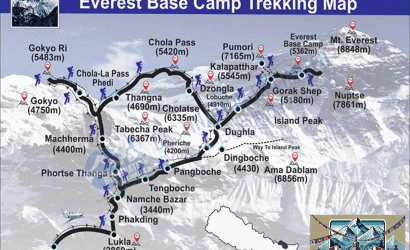
Dolpo Great Himalayan Trail Map