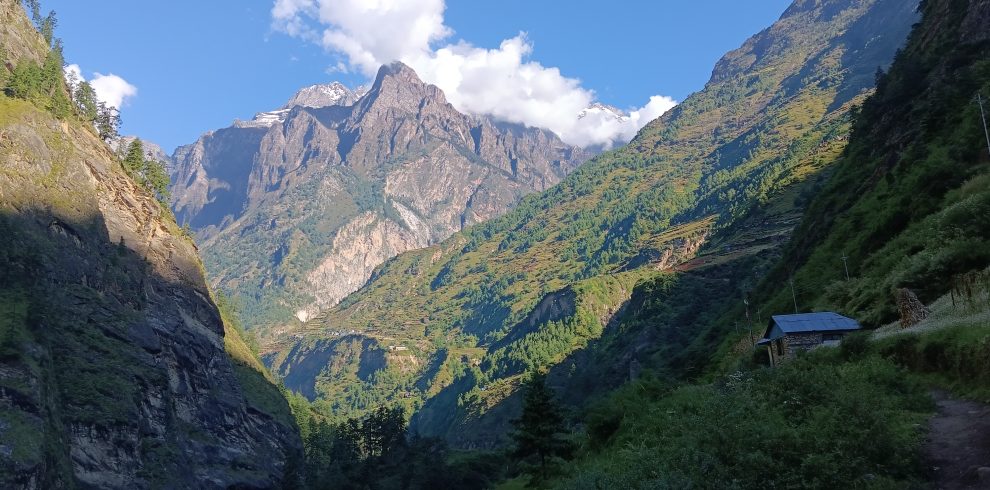


Tsum Valley Trek lies in northern Gorkha. It is rich in ancient art, culture, and religion. The locals here trace their origin to Tibet and speak their own dialect. Being one of the remotest Himalayan valleys, the pristine beauty of this valley makes the trek much more enjoyable and pleasant. The valley provides outstanding views of several mountains, including Ganesh Himal, Shringi Himal, and Boudha Himal.
The treks to the Tsum Valley were restricted as recently as 2008. The villagers are highly spiritual evident from the several monasteries located here. The Rachen and Mu Gompas are the most prominent monasteries in this valley. This region is also rich in biodiversity, and the forests, rivers, and caves make this valley worth visiting.
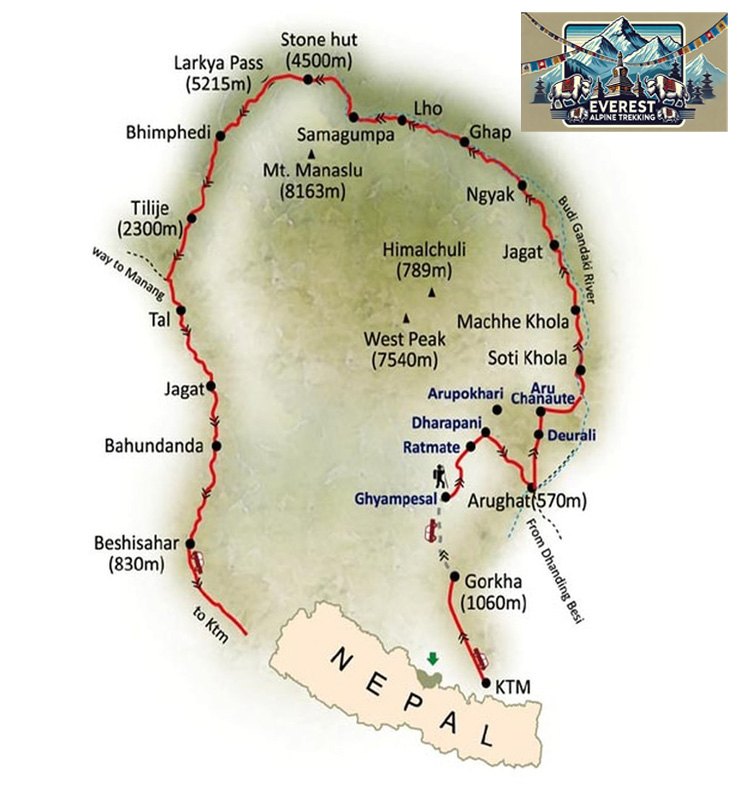
Your trek will start with a scenic drive to Arughat, followed by Soti Khola. We follow the Budhi Gandaki valley upstream in the north, passing by many villages and forests full of rhododendron and pine trees. From Soti Khola, we head to Jagat and then to Lokpa, the entrance to the Tsum Valley.
Overview
Tsum Valley Trekking ,Hidden within the pristine beauty of Gorkha, the TSUM valley trek lies before the Manaslu range of Nepal. Manaslu is the world’s eighth-highest mountain, with a height of 8,163 meters. The Valley lies in the central north of Nepal, in the northern part of Manaslu.
This pristine mountain harbours many beautiful valleys that lie within a few hundred kilometers range from Kathmandu. One such remote valley in Nepal is the Tsum Valley. The tourists have recently recognized the unbelievable natural beauty and the rich culture of Tsum.
The Tsum Valley trek is the most underrated adventure in Nepal. The name Tsum represents a Tibetan word that marks “Tsombo”; meaning is Vivid. Even the name reflects the diverse culture, unique lifestyle, and myth/ mystery of this village. From the insight into the polyandry system (off-course illegal) to the tales of Yeti or Abominable snowmen, the valley has so much to uncover.
The Tsum Valley Trek with Manaslu is a one-of-a-kind trek during which you can see panoramic mountain vistas. You can see Manaslu, Ganesh Himal, Himalchuli, and dozens of other peaks on the journey.
This trek is a hidden jewel of Nepal, where its visitors can see several ancient monasteries, gompas, Mani Walls, rotating prayer wheels, and fluttering prayer flags along the route. The rich Tibet culture will surely give you salvation and peace.
Recently upgraded to a teahouse trekking trail, you can now conquer Tsum’s beauty while enjoying the comfort and luxury of newly built teahouses.
Trip Highlights
- The Tsum Valley was not open to outside trekkers until 2008.
- This is a conservation area, with unique and elusive wildlife befitting this remote area.
- Not only are there rough mountain trails but pine and rhododendron forests, valleys, and rivers.
- Mt Manaslu is the 8th highest mountain in the world!
- Visit the cave where the ancient Buddhist scholar and yogi, Milarepa, meditated hundreds of years ago.
- Meet locals whose culture is very close to Tibet, in fact, many people living in this area migrated from Tibet in the distant past.
- Experience the Tsum Valley’s unique festivals, such as Lhosar (Tibetan New Year).
- Discover the hidden valley’s sacred monasteries, such as Mu Gompa and Rachen Gompa, which are rich in history and spiritual significance.
- Get a glimpse across the border into Tibet.
- Walk over high suspension and cantilever bridges with the rivers raging below.
Itinerary
Our airport representative will welcome you when you arrive at Tribhuwan International Airport. You will be driven to the hotel in a private vehicle. You can take a little break at your accommodation and then come see us in person to learn more about the Tsum Valley Trek Itinerary.
After breakfast, your trek guide will be introduced to you at your lodging. He will go through your Tsum Valley Restricted Area Trek Permit and everything else you will need for the trek. You will need your passport, three passport-size photos, and proof of travel insurance. You might unwind or go last-minute shopping during your free time. A tour of Kathmandu's world heritage monuments, including Swayambhu, Boudha, Pashupatinath, and Kathmandu Durbar Square, may be arranged upon request.
After an early breakfast, your Tsum Valley Trek Itinerary will start with public bus travel from Kathmandu to Arughat then a shared jeep to Machha Khola. The beautiful landscapes, terraces, and verdant slopes of Langtang Himal, Annapurna, Manaslu, and Ganesh Himal will be visible to you. After traveling past farms, communities of the Gurung and Magar people, and cascading waterfalls, you will arrive at Machha Khola.
You could reach the Sal Forest by going across a magnificent suspension bridge. After leaving the jungle and crossing the Budhi Gandaki River, you will need to climb a challenging slope. Along these paths, you may observe wonderful rice fields before arriving at Labubesi village. You will eventually arrive in the village of Machha Khola, where you may relax and prepare for the following day.
There are many ups and downs along the Tsum Valley Trekking Route from Machha Khola to Jagat, making it fairly challenging. You will travel via the Tharo Khola to get from Machha Khola to Khorlabesi. Khorlabesi is another little yet lovely Gurung village. Another short steep climb will get you to Tatopani, a hot springs site where you will spend some time resting in the natural sauna. You will reach Doban after traversing the suspension bridge over the Budhi Gandaki River and climbing the stairs. Yaruphant is passed through before reaching the Yaru River.
You will pass the Cantilever bridge in Yaru Bagar, which was constructed using Swiss engineering in 2016 as a result of an earthquake. You will next bridge the Budhi Gandaki River on the western bank, ascend the mountain, and go down the river to reach Jagat village. The police checkpoint at Jagat, which serves as the entrance to the Manaslu Conservation Area, is where you will register your Tsum Valley Trek Permits.
Jagat is a sizable Gurung settlement situated on a level plain. Following this agriculturally oriented settlement, you will climb a rugged slope to Salleri, where you will be rewarded with breathtaking views of Mount Sringi. You will go through Nepal's longest suspension bridge and ascend to Lokpa, which is situated in the north of Philim, after descending to Sirdibas, a historic Buddhist hamlet. You will reach Ekle Bhatti through the dense forests after about an hour of climbing. You will reach a stunning canyon and a crossroads as you make your way up the Tsum Valley Trek Route among the pine forests. To get to Tsum Valley you will take the right-hand trail, where you will spend the night on Lokpa.
A tropical rhododendron and pine forest, which is completely silent, is traversed along the route. You will experience a number of ups and downs before arriving at a little suspension bridge. The Tsum Valley Trekking Route is rerouted through Ripchet and Chumling from this bridge. You will stroll across the bridge and continue down the path, passing a little stone wall. Ganesh Himal may be seen from a monastery at the summit of the Chumling hamlet. A few of Chumling's monasteries are Gurwa Gumba, Mani Dhungyur, and Panago Gumba. A substantial Chorten stands in the middle of the field, which improves the view of the little valley.
The day begins with a suspension bridge crossing to the bank opposite Chumling. The Tsum Valley Trekking Route follows the Syar River all the way down to Domje. You must keep climbing up from Domje in order to reach Chhokang Paro. You will reach Gho Village, which contains a neighborhood teashop, after going through Rainjam and crossing another bridge. Another two-hour climb takes you to Tsum, where you will find the charming traditional town of Chhokang Paro. On a clear day, Chhokang Paro offers a view of Himalchuli and Ganesh Himal in the distance. You will arrive at Lamagaon and then Rachen Gompa, where you are going to stay today, after traveling via Chhokang Paro.
Amazing picturesque hikes from Rachen Gompa to the Nile start after breakfast. The Nile is the location, where you will have your lunch, and then you will leave your large luggage there and take a day trip to the Mu Gompa. Your Tsum Valley Trek Route will ascend beautiful routes to Mu Gompa, the greatest monastery in the area and the highest point in Tsum Valley. Mu Gompa will astound you with its own world, which is a flat, bowl-shaped valley surrounded by mountains. Mu Gompa has neither a teahouse nor accommodation facilities. The Monastery, which does not have much space, is where those who want to remain at Mu Gompa must do so. Therefore, you will return to the Nile after visiting Mu Gompa.
You will go to Rachen Gompa today after enjoying a great breakfast at the Nile. The Tsum Valley Trek Route will then turn south and travel towards Chumling by way of Chhokangparo. A small white Gompa at Gho may be seen after two hours of hiking. You will soon find a wooden bridge over Siyar Khola on a route that descends from this monastery. You will arrive at Domje, which is home to a school and a clinic for Tibetan herbal medicine, after crossing this bridge.
You may view multiple mani walls and prayer flags from the route as you go east from Domje through a grove of pine, juniper, and rhododendron. To go to Lungdang Gompa, you must climb again through the silver pine forest. Around forty nuns reside at Gumba Lungdang, which is renowned for its ferocious puja, which lasts from 6:00 to 7:30 pm. Beautiful and breathtaking views of the surrounding mountains may be seen from the gompa.
You will go on a challenging journey today to the Ganesh Himal Base Camp. Although the walk begins with an ascent, the scenery will more than makeup for it. You will pass through smaller valleys on the Tsum Valley Trek Path. The pathways may not be evident because few people travel to Ganesh Himal Base Camp, but don't worry—our guides will show you the way. Ganesh Himal Base Camp will be reached in four hours or so. You will return to Gumba Lungdang for the night after admiring the views from Ganesh Himal Base Camp.
Your Tsum Valley Trekking Trail will return to Lokpa after a delightful stay in Gumba Lungdang. You will first descend to Domje, take the higher trail, then cross the Laudang Khola. You will go south from Domje to Ripchet, traveling through lovely, deep forests and over suspension bridges. After that, you will drop to Batti Ghumlong and then slightly rise to reach Lokpa.
Following an enjoyable night in Lokpa, your Tsum Valley Trekking Path will descend into Jagat, where you will re-join the Budhi Gandaki River. Several vistas of the mountains may be seen from the pathways. This will be a lovely and simple trip for your legs as you pass through woodlands and downward terrain. Before reaching the settlement of Sirdibas and Salleri, you must traverse a number of suspension bridges.
Your Tsum Valley Trekking Route will descend to Lapubensi after an early-morning meal. As you stroll downward, the journey will be mainly nice, but the thrill comes from the suspension bridges. Before getting to Lapubensi, you will pass through quaint communities like Yaruphant, Dobhan, Tatopani, and Khorlabeshi to get to Machha Khola.
Now we can drive from Machha Khola to Kathmandu so You will board a vehicle and travel to Arughat Bazaar from Soti Khola. You will arrive in the Arughat Bazaar after some time spent driving. You may go to Kathmandu in around 7 to 8 hours by public bus from Machha khola. You will be guided to your lodging in Kathmandu by our representative. To honor the successful conclusion of the Tsum Valley Trekking Journey, we will enjoy a farewell dinner in the evening.
Departure from Kathmandu. A drop from the hotel to the airport 3 hours before the scheduled time of the flight is arranged in a private tourist vehicle. You can also opt for another package with Everest Alpine Trekking and extend your stay.
Cost Includes
- Airport picks up and drops by private Vehicle.
- 3 nights’ standard accommodation in Kathmandu on BB base.
- All permits such as MCAP and Tsum Valley Special.
- Trekking gear duffel bag for your trekking stuff.
- First Aid and Eco trained English Speaking professional guide.
- All-night lodge accommodations while you are on a trek.
- 3 times meals a day such as Breakfast, Lunch, and Dinner during the trekking.
- Public bus to Machha Khola and Kathmandu from Machha Khola.
- Tourist service charge, VAT.
- Farewell dinner.
Cost Excludes
- International airfare, travel insurance and Nepal visa.
- Lunch and Dinner in Kathmandu .
- Porter to carry your luggage during the trek if you would like to take a porter it will cost you USD 280 for each porter (One porter can carry a maximum of 25 KG so one porter between two trekkers is recommended ) .
- Private JEEP to the trek from start point to end point. If you prefer to use private JEEP to from Machha Khola.
- One JEEP could share between 5 people maximum.
- Personal nature expenses such as all kinds of drinks, beverages, donations, shopping, hot showers, Tips, etc.
FAQS
Yes, you can. No matter who you are, as long as you are reasonably fit, can walk for 5-6 hours a day and trek/hike a few uphills,Everest Alpine Trekking team will support you to the fullest to transform your dream into reality.
Spring and autumn are the best seasons for Tsum Valley Circuit trek. Spring (March, April, and May) and Autumn (September, October, and November) are the best months for trekking as the weather will be clear and calm. Also, you can get the opportunity to view High mountains including Tsum Valley with the full of Snow.
You will need three kinds of permits issued by the Government of Nepal. Tsum Valley Restricted Permit Tsum Valley trek permit costs USD 100.00 for the first seven days and USD 15.00 each additional day during September to November Tsum Valley trek permit costs USD 75.00 for first 7 days and USD 10.00 each extra day from December to August. Tsum Valley Conservation Area Permit (MCAP) Entry fee for SAARC Nationals is Nepali Currency 200 per person and for other Nationals is Nepali Currency 3,000 per person. Annapurna Conservation Area Permit (ACAP) Entry fee for SAARC Nationals is Nepali Currency 200 per person and for other Nationals is Nepali Currency 3,000 per person. Tsum Valley Restricted Permit (Optional: if you want to go to the Tsum Valley) If you choose the Tsum Valley trek, it costs USD 40 for each person per week.
No, there is no age limit for the trek to Tsum Valley Trekking but, you need to be in good physical shape and have a positive attitude. We also suggest you to prior to the excursion though we suggest you to please see your doctor and obtain necessary permission and advice, as well as medications for traveling in extreme altitude prior to the excursion.
During trekking, you will be served meals in the teahouses. Typical meals are noodles, rice, pasta or potato dishes along with vegetables and egg/chicken/meat dishes. Other items mostly served as breakfasts include egg, pancake, bread, porridge, muesli, and toasts with peanut butter and honey.
Accommodation is not an issue in Tsum Valley Trek as trails are usually less crowded and new and improved tea houses are opening up all the time. The tea houses and lodges are ready to serve trekkers.
Most of the teahouses on the Tsum Valley Trekking trail have squat toilet facilities but recently built lodges have western-style toilets as well. Nowadays, flush toilets are also being introduced with number of increasing trekkers each year.It is highly recommended to carry your own toilet paper and other required toiletries. Do not expect full bath or daily showers while on the Tsum Valley trek. If you insist on taking a hot shower daily, spare a lot of money for that. For hot water showers in the trek, you have to pay a few dollars at a time.
What you want to wear depends on you but we suggest you wear warm clothes during the Tsum Valley trekking. A down jacket, thermal longs and top, comfortable trekking trousers, t-shirts, fleece, windproof jacket, hat, scarf, and gloves might be useful. There are numerous trekking shops in the Thamel area of Kathmandu where you can get all of these items in both local and branded stores alike. Everest Alpine Trekking may also accompany and assist you if required.
During the Tsum Valley trekking, you will be on a long journey for which you will need two bags to keep your belongings. A rucksack/duffle bag and a day bag for personal items. Everest Alpine Trekking will provide you with a duffle bag (which is need to refund after the trek) that you can use throughout your entire journey and even afterward. These bags are durable and hence perfect for any kind of trekking journey. While the duffle bag will be carried by the potters, you will have to carry a day bag on your own. A day bag is a small backpack that has enough room for everything you will need on a day hike such as lunch, water, extra clothing and perhaps a few personnel items like camera, battery chargers, etc.
If possible, we suggest you bring your own equipment. However, sleeping bags and down jackets will be provided to you by Everest Alpine Trekking. With regards to trekking poles, if you are used to walking with it then take them with you, as you will probably find them useful especially on the way down. They are not essential though and the walk is manageable without them. It is mostly a personal preference. If you prefer to take the trekking poles with you on the trekking then you can either bring your own pole or buy it from numerous options available in Kathmandu itself.
Yes, if you have a bag of extra clothing for when you return from the trekking, you will be able to store it safely in Kathmandu at Everest Alpine Trekking office. Also, the storage facility is provided by most hotels and lodges in Kathmandu or you can also store it in our office for the duration of the trekking.
Our itinerary has been specially tailored to prevent any kind of AMS (Acute Mountain Sickness) while moving up to higher altitudes. Normally, altitude sickness starts from 3,600 meters and above. You will be trekking at a relatively slow and gradual pace as part of the acclimatization process. Cut off caffeinated, alcoholic and smoking items. Drink at least 4 liters of water a day. Trek slow. Don’t skip the acclimatization days. Better to continue with Diamox (if any symptoms show up). Drink Garlic Soup. In the higher elevation, there is less oxygen in the air and this is more so while crossing high passes. Our expert guides will advise you on how to avoid AMS and treat it when/ if required.
Make sure to have both medical and evacuation insurance before coming to Nepal for Tsum Valley trekking. You should be careful in choosing a policy while traveling to a Himalayan country like Nepal as some insurance companies may make special exceptions for adventure travel. If you are confused about the insurance, please inform us and we will help you. It is usually better to arrange your insurance in your country before travel.
The trekking will be 5-7 hours a day depending upon the landscape and destination.
It takes 13 to 21 days to complete Tsum Valley Trek depending upon the mode of transportation and packages of Everest alpine Trekking.
We at Everest Alpine Trekking Team always have the safety, comfort, and satisfaction of our valued customers as our foremost priority at all times, and we assure you a wonderful and unforgettable time with us in our beautiful country. Sherpa team members of Everest Alpine Trekking will be carrying all the necessary gear, equipment, and first aid kits and they have extensive first aid training. If a trekker falls sick on high altitude, the leader will decide whether to continue the trek. In case of emergency, Everest Alpine Trekking have a rescue helicopter to bring you back from the higher elevation. Moreover, Everest Alpine Trekking also provides oximeter to monitor the oxygen level at high altitude and offers regular health check-up facil
As Tsum Valley has recently gained popularity among trekkers, not many facilities are available on the trails. Due to its isolation and off-road trails, the region is not yet connected to the outer world via proper roads. So, you will need to take local buses or hire a private jeep to reach the starting point of the trek to Arughat or Sotikhola. A local bus would cost around US $15 per person whereas a jeep would cost between $150 and $200 each way but is worth the convenience than the packed buses. If you are traveling in a group, the cost can be shared by all and would be around $36 per person. The same rate would apply to your return trip from Tal or Besisahar to Kathmandu.
Everest Alpine Trekking will provide one porter for two trekkers to carry 25 kgs of luggage (maximum 10 kg for each trekker). Please be sure your porters are not overloaded because they do not carry only your equipment but also lift your spirit to reach new heights, and your love, affection, and generosity can be the reason for them to work hard to take you to your destination.
Garlic soup is a must while trekking. Everest Alpine Trekking recommend trekkers to drink green tea, lemon tea, hot lemon ginger tea and drink at least 2-4 liters of water a day. However, it is better to avoid alcohol and alcoholic beverages, caffeinated items, and hot-chocolates at high altitude.
Everest Alpine Trekking also encourage to avoid dairy and cheesy items and strongly suggest not to consume them during the trek. Our packages are suitable for both vegan and vegetarians.
Most of the tea houses/ lodges have electricity whereby you will be able to charge your iPod or camera batteries. Please note that lodges/tea houses will charge you some extra money for the services. The fee may vary from 4 USD to 8 USD per hour.
Everest Alpine Trekking will introduce dozens of shops selling knock-off gear in Kathmandu. You can also barter those gears at the knock-off places but be sure you keep the receipt safely. Moreover, you can rent the needed gears if you do not want to buy them.
Your guide and porters are a big reason why you got a chance to feel something very few can have. Apart from guiding and carrying your necessities and being mindful of your safety, they want to see you happily succeeded more than anyone like family and help you successfully complete the trek safely. So, your tips reflect gratitude towards them. So, tipping is a recommended culture for porters and guide in Nepal as a gesture of thankfulnes
Map