

The Makalu Base Camp Trek is one of Nepal’s most remote, wild, and adventurous treks, leading to the base of Mount Makalu (8,485 m)—the fifth-highest mountain in the world. Located in the far eastern Himalayas, this trek offers an untouched experience with dramatic landscapes, deep valleys, high alpine passes, and exceptional biodiversity.
This trek is ideal for experienced trekkers looking for true wilderness, solitude, and raw Himalayan beauty, far away from crowded trails.
Mount Makalu was first successfully climbed in 1955 by a French expedition led by Jean Franco, making it the last of the world’s eight-thousand-meter peaks to be summited.
The Makalu region remained isolated for centuries, inhabited mainly by Rai, Sherpa, and Tibetan-influenced communities. Trekking routes opened much later than Everest and Annapurna, preserving its pristine natural and cultural heritage.
Overview
Makalu Base Camp Trek Itinerary is the chance to visit the Makalu Barun National Park. Established in 1992, the park covers an area of 2,330 square km and is home to a rich diversity of flora and fauna, including rare and endangered species like the red panda and the snow leopard. In addition to wildlife, the park also boasts a spectacular landscape of glaciers, waterfalls, and pristine forests. Aside from the spectacular views, the Makalu Base Camp Trek also offers a rich cultural experience.
You will pass through several traditional Sherpa villages, providing an opportunity to learn about the unique culture and traditions of the Sherpa people. The Sherpa people are known for their hospitality and warmth, and it is not uncommon for them to invite trekkers into their homes for a cup of tea or a meal
Highlights
- Base camp of the 5th highest mountain in the world.
- Remote Barun Valley trekking.
- Stunning views of Makalu, Everest, Lhotse, Chamlang, Baruntse.
- Crossing high passes like Shipton La.
- Untouched villages and traditional lifestyles.
- Wildflowers, glaciers, and waterfalls.
- Very few trekkers and true solitude.
Itinerary
When you arrive at the Kathmandu International Airport, a representative from Everest Alpine Trekking will welcome you and drive you to one of the city's three-star hotels. You may take a nap at your hotel or wander through Thamel to finish off any last-minute shopping. Following that, you may come and see us at our office to learn more about the Makalu Base Camp Trek itinerary.
Your Makalu Base Camp Trek Guide will meet you at your accommodation after breakfast for an introduction. Briefings on the walk and other important information will be provided at this pre-trip meeting. For the Makalu Base Camp Trek Permit, you must bring your passport, three pictures the size of a passport, and proof of travel insurance. During your leisure time, you may relax or go exploring in the Kathmandu Valley for any last-minute shopping. If you desire it, a tour to one of Kathmandu's world-heritage monuments, such as Swayambhunath Stupa, Boudhanath Stupa, Pashupatinath Temple, or Kathmandu Durbar Square, will be organized.
You will be picked up from your hotel and transported to the airport in Kathmandu where you will board a domestic aircraft to Tumlingtar to begin your Makalu Base Camp Trek. The trip normally lasts for 35 minutes, and the windows offer fantastic views of the Alps. To reach Kandbari, a significant town in the area and home to the government authorities, you will need to travel for around 30 minutes up a winding, hilly route.
You continue on a twisting dirt road until it reaches its highest point at 1,960 meters before descending to Chichila at 1,900 meters, a little settlement with a police checkpoint where you must show your Makalu Base Camp Trekking permit. There are lovely views of the slopes covered in trees in the area. From here, it's a rocky ride for the majority of the way to Num since the road begins to degrade from Chichila.
Today, you will travel a lengthy, steep descent to the Arun River and a lengthy ascent to Seduwa. The Makalu Base Camp Trek trail is on large stone stairs all the way to the river at 770 meters and descends through cardamom fields. After crossing the suspension bridge over the Arun River, you will start the arduous ascent to Seduwa, through forests of enormous bamboo and humming village activity. In order to check your permit, your guide will go to the Makalu-Barun National Park checkpoint. Seduwa has a school, several homes, a few businesses, and a few tea houses strewn around the mountain.
Without the strenuous ascents and descents like yesterday, today's trek is wonderful. As you approach the Sherpa settlement, you will start up a trail with numerous stone steps and pass by a number of mani walls. Your Makalu Base Camp Trek Route will go through rhododendron, and bamboo woods, as well as several tiny farms are strewn across the slope and cardamom plantations. Today's trek is definitely interesting and uneven. You will arrive at the little community of Chyaksa Danda at 1,900m in around two hours.
You may occasionally have to cross certain streams on sturdy wood bridges while walking through areas of a deep forest. Although getting there takes longer than you may expect, as you contour on an uneven trail, you will eventually see your goal, Tashigaon, on the slope ahead. You eventually make your way down to a log bridge just before making the last ascent of stone stairs to Tashigaon.
You will leave Tashigaon and climb up some stone stairs to start your Makalu Base Camp Trek. You eventually cross a log bridge and keep climbing through a breathtaking rhododendron woodland. You arrive in Dhara, which has a tea house and is located at 2,867m, after traveling for about three hours. Since this is your only opportunity to stop for refreshments until reaching Khongma, you probably have your lunch there.
After leaving Dhara, it takes about an hour of difficult climbing to reach Unshisa at 3,200m, where you cross a huge rock. More arduous hiking on stone stairs through a rhododendron woodland is required from Unshisa. After several hours of laboriously climbing from Unshisha, you finally arrive at a stone rest area with prayer flags, and another 45 minutes of walking will take you to Khongma Danda at 3500m. There are three lodges in Khongma, and this location could also have a lot of snow.
We strongly advise you to go up to the Khongma La today since appropriate acclimatization is crucial. Today is the day for acclimatization, according to your Makalu Base Camp Trek itinerary. You leave your tea house and start walking through rhododendron bushes up stone stairs till you reach the pass at 3,890m. You should be able to get to the pass in about an hour. If you are eager, your guide will urge you to go a bit farther. You then return to Khongma, fit and well-acclimatized, ready to take on the four passes tomorrow, the first of which is, of course, the Khongma La.
Today is a particularly wonderful day since you will be traversing four high passes with airy traverses and dramatic ridge portions that provide nearly nonstop breathtaking vistas of snow-capped peaks. Your first pass of the day, the 3,890m Khongma La, is reached after about an hour of climbing through rhododendron bushes. Makalu and Chamlang may be seen from Khongma La Pass. Before beginning its ascent into the second pass, your Makalu Base Camp Trek Route will drop for a bit. After climbing some challenging stone stairs, Sano Pokhari Danda, at 4,105 meters, is reached, with Sano Pokhari Lake below.
The Shipton La, which is 4,200 meters above sea level, is reached after several undulations. A mani wall and cairn next to the shelter serve as markers for the pass. To reach Kalo Pokhari Lake at 4,080m, you will descend across less severe terrain. Hindu pilgrims who are traveling there for the Janai Purnima Festival will find it decorated with prayer flags. Your final pass of the day, the Keke La at 4,170m, is a simpler ascent from the lake. After around another 45 minutes of descent, you will arrive at your lodge in Dobate, which is a much-needed sight after the arduous four-pass climb!
This morning's descent will take you through rhododendron and pine woods, which will be really enjoyable. Through the woodland, there is an abrupt slope that might be treacherous if there is still snow on the ground. You will eventually arrive at the river, where you will start your Makalu Base Camp Trek on a trail that runs beneath a big landslide region. You arrive at the tea house at Themathang Kharka, 3,500m, after a short climb.
From Dobate, it takes around four hours to get here. Just before you get to Themathang, there is a magnificent waterfall. From here, you must continue walking for a while until reaching a wooden bridge that spans the Baron Khola. The river is now on your left as the path undulates. You may get to your overnight lodging in the meadows of Yangri Kharka in around 1.5 hours from the tea store in Themathang.
The stroll will be nice and level, with the river on your left and the alluring aroma of juniper accompanying you. The Makalu Base Camp Trekking Trail is lined with a variety of vibrant prayer flags. Peak 4, Peak 6, Peak 7, and Yaupa dominate the vista ahead as the towering cliffs climb on either side of you. A visual feast of craggy snow-covered mountains, sheer cliffs, waterfalls, and sacred caves awaits you today.
After around 2.5 hours of trekking, the route widens as you pass the fields of Jhak Kharka, Yak Kharka, and finally Merek, where a welcoming tea house gradually appears. From Merek, it will take around two hours to go to your tea house in Langmale. Peak 7 serves as an amazing background to the lodge rooms, adding to the area's exquisite vistas. A prayer flag-covered mani wall is located just in front of the line of rooms.
You will start your ascent on a sound course for your Makalu Base Camp Trek route. As you zigzag your way across the valley, maintain the river on your left. There will be a new stunning feature to awe at as you round each corner. While there are some sections where you must step from boulder to boulder, the majority of the time you are on a normal, sandy track. As you go forward, you can see Peak 4. You will arrive at Shershong, at 4,630m, after a few hours of trekking. Shershong makes a nice camping location, and it is a broad, level area with a lockable tiny stone house. The tantalizing sight of Makalu eventually appears.
You will be curious to see the base camp as you navigate a few curves. The lodges will eventually come into view. Your long-awaited goal is reached five minutes after you descend and cross the river. Makalu, the fifth-highest peak in the world, absolutely dominates the scene, as one might anticipate. Around the base camp, it's common to observe Tibetan snow cocks, hill pigeons, black redstarts, and mountain finches.
Today, reaching the ridge, which is located around 5,300 meters above the base camp, will provide you with the most beautiful panoramic vistas. You use the log bridge to cross the river, then spend around three hours climbing a hazy, rather ill-defined trail. This vantage point offers spectacular views of Makalu, Peak 7, Peak 6, and Peak 4 as well as Everest, Lhotse, and Nuptse. When you have got your fill of mountain drama, return to base camp by following your previous steps.
It should take 4-5 hours to get back and forth. It's a challenging endeavor because it's steep and the altitude will definitely hit above 5,000m. There are other gentler choices, including taking a route to see the lakes past base camp. You may also climb a much shorter ridge immediately above base camp, and there is a little hill marked with prayer flags at the head of base camp that is about an hour's walk out and back.
You will leave Mount Makalu's stunning grandeur behind with a sorrowful heart and start walking back to Yangri Kharka. Getting to the Shershong meadow, which is indicated by a cabin covered in a bright orange tarp, will take around 1.5 hours. You will return to Langmale after another hour or two, where you can have tea and possibly lunch. You can reach the Merek tea house next after 1.15 hours of trekking. Before continuing your Makalu Base Camp Trek Route through pine trees back to Yangri Kharka, it is a good idea to relax here with a cup of tea. From the tea house in Merek, it will take 2 to 3 hours to go to Yangri Kharka.
It will be a beautiful, leisurely meander today as you follow the river down to the tea house at Themathang, passing a lot of rhododendron shrubs on the way. Just before Themathang, there is a wooden bridge that must be crossed. The journey to Themathang will take around 1.5 hours. The landslide region will eventually need to be traversed, which will take around 1.5 hours. Following a section of undulation, you will begin a hard ascent through the rhododendron woodland. As you get closer to the tea house at Dobate, the elevation gradually eases and becomes gentler along the Makalu Base Camp Trek Route.
As per your Makalu Base Camp Trek Itinerary, this is your final chance to experience the mesmerizing vistas of the lofty mountains, including Kangchenjunga. You will start your ascent to the Keke La, which will take about 1.5 hours. Reaching the Shipton La, which is 4,200 meters above sea level, will take a further 1.5 hours. You will reach the huge cairn that marks Sano Pokhari Danda at 4,105m after another hour of contouring around the slope.
You will return to the last pass, the Khongma La at 3,890m, which is identified by a mani wall, after another hour of undulations. You will arrive at Khongma after descending about 250 meters, mostly on stone stairs. In the snow between the rhododendron bushes, keep your eyes out for blood pheasants, which are infrequently spotted. From Khongma, you will descend to Danda Kharka, which will take a further two hours.
As you leave the mountains and make the long, steep descent down to civilization, you will have time to consider the breathtaking adventure you have just completed. The three-hour journey from Danda Kharka to Tashi Gaun on your Makalu Base Camp Trekking Route will take you through rhododendron trees, steep terrain, and meadows. You will go across terraced farms from Tashi Gaun with lovely mountain vistas. You will traverse a mountainside after leaving the Makalu-Barun National Park, descend the Barun River, travel through bamboo and rhododendron woods, and then arrive at Seduwa, where you will spend the night at a local lodge.
All the way down to the Arun River, there will be a long, somewhat difficult trek, mostly on stone stairs. As you descend farther into the forest, the temperature will be quite warm. After crossing the river, you will have to climb all the way back to Num. The path ascends and descends through beautiful woodland before arriving at the town of Num. Drive to Tumlingtar's scenic surroundings on Nepal's winding mountain roads. In addition to the breathtaking scene of snow-capped mountains and verdant surroundings, you will also see hillside settlements and terrace farms. Now that you have finished the difficult but worthwhile Makalu Base Camp Trek, you may congratulate yourself.
Today, you will take a brief, scenic morning flight from Tumlingtar to Kathmandu. You will be taken to the hotel after you arrive in the city. Green Valley Nepal Treks will schedule a farewell dinner in the evening to celebrate the accomplishment of the Makalu Base Camp Trek itinerary. Spend your leisure time exploring the city or purchasing gifts for your loved ones back home.
Three hours before to the flight's planned departure time, a drop-off in a private tourist car is provided from the hotel to the airport. You can extend your stay by selecting a different package from Everest Alpine Trekking.
Cost Includes
- Pick up and drop service from/to Kathmandu International Airport.
- 3 nights’ accommodation in Kathmandu at a standard hotel.
- Flight ticket to/from Tumlingtar.
- Accommodation during the trekking Tea House/Homestay .
- Breakfast, Lunch, and Dinner during the trek .
- One professional English-speaking guide.
- All necessary papers works and permits.
- All government and local taxes if necessary.
- Farewell Dinner.
Cost Excludes
- International airfare and Nepal Visa fee.
- Excess baggage charges.
- Lunch, and Dinner while you are in Kathmandu.
- Travel/medical insurance.
- Porter if necessary which you can add at the time of booking.
- Personal expenses e.g. phone calls, laundry, bar bills, and extra porters.
- Tips for guides and porters (expected at the end of Makalu Base Camp Trek).
FAQS
Makalu Base Camp is located in eastern Nepal, inside the Makalu–Barun National Park, at the base of Mount Makalu (8,485 m), the fifth-highest mountain in the world
Makalu Base Camp lies at an altitude of approximately 5,250 meters).
The trek usually takes 18 to 22 days, depending on the itinerary, acclimatization days, and weather conditions.
This trek is considered challenging and is recommended for:
01: Experienced trekkers
02: Physically fit adventurers
03: Those with prior high-altitude trekking experience
04: Steep ascents, high passes, and remote terrain increase the difficulty.
The best seasons are:
01: Spring (April–May): Best weather and blooming rhododendrons.
02: Autumn (September–October): Clear skies and stable conditions.
03: Winter and peak monsoon are not recommended.
01: Makalu–Barun National Park Entry Permit.
02: TIMS Card.
03: Restricted Area Permit (if route variation applies).
Yes. Due to the remote and challenging nature of the trek, hiring a licensed trekking guide is strongly recommended, and in many cases essential for safety and logistics.
01: Teahouses are available in lower villages.
02: Camping is required in higher sections near the base camp.
03: All camping equipment and meals are arranged by the trekking team.
01: Local Nepali meals in lower regions.
02: Simple trekking meals in camping areas.
03: Limited menu choices due to remoteness.
04: Vegetarian options are usually available.
Yes. Since the trek reaches above 5,000 meters, there is a risk of altitude sickness. Proper acclimatization, slow pacing, hydration, and experienced guides help minimize risks.
You should be able to:
01: Walk 5–7 hours per day.
02: Handle steep and rugged terrain.
03: Carry a daypack at high altitude.
04: Strong cardiovascular fitness and endurance are essential.
No.This trek is known for its extreme solitude. You may go days without seeing other trekking groups.
- Is Wi-Fi or mobile network available?
01: Mobile network is very limited
02: Wi-Fi is mostly unavailable
03: This trek is ideal for disconnecting from modern communication
The Makalu–Barun region is rich in wildlife, including:
01: Red panda
02: Snow leopard (rare)
03: Himalayan black bear
04: Musk deer
05:Diverse bird species
Yes, with proper planning, guides, and equipment. However, the remoteness means self-sufficiency and preparation are crucial.
Accommodation at and near base camp is camping only, with tents set up by the trekking crew.
01: Warm days and cold nights in spring/autumn
02; Sudden weather changes at high altitude
03: Snow possible above 4,000 meters
Costs usually range from USD 2050 to 3,500 per person, depending on:
01: Group size:1/ 15 pax.
02: Camping logistics
03: Guide and porter support
04: Trek duration
Yes. Advanced trekkers can combine it with:
01: Makalu to Everest (Three Passes) Traverse
02: Baruntse or Mera Peak expeditions
03: These require additional permits and experience.
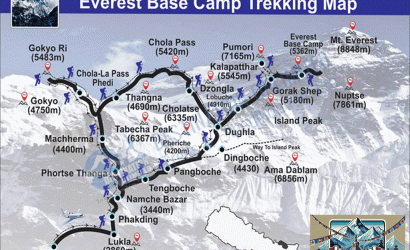
Makalu Base Camp Trek map